


Equipoise
Equipoise
100 in stock
EquiPoise redefines computerized dynamic posturography with its precision, versatility, and user-friendly design, empowering clinicians to make informed decisions in balance assessment. It delivers precise vestibular assessments with real-time data, integrating advanced posturography and customizable protocols to support neurological, orthopedic, and sports rehabilitation.
What's included?
- Equipoise Forceplate Platform
- USB Cable
- Equipoise Cushion
- Fall prevention belt




Product Features
How EquiPoise works?
- Equipoise is an innovative computerized dynamic posturography system that assesses and rehabilitates patient balance.
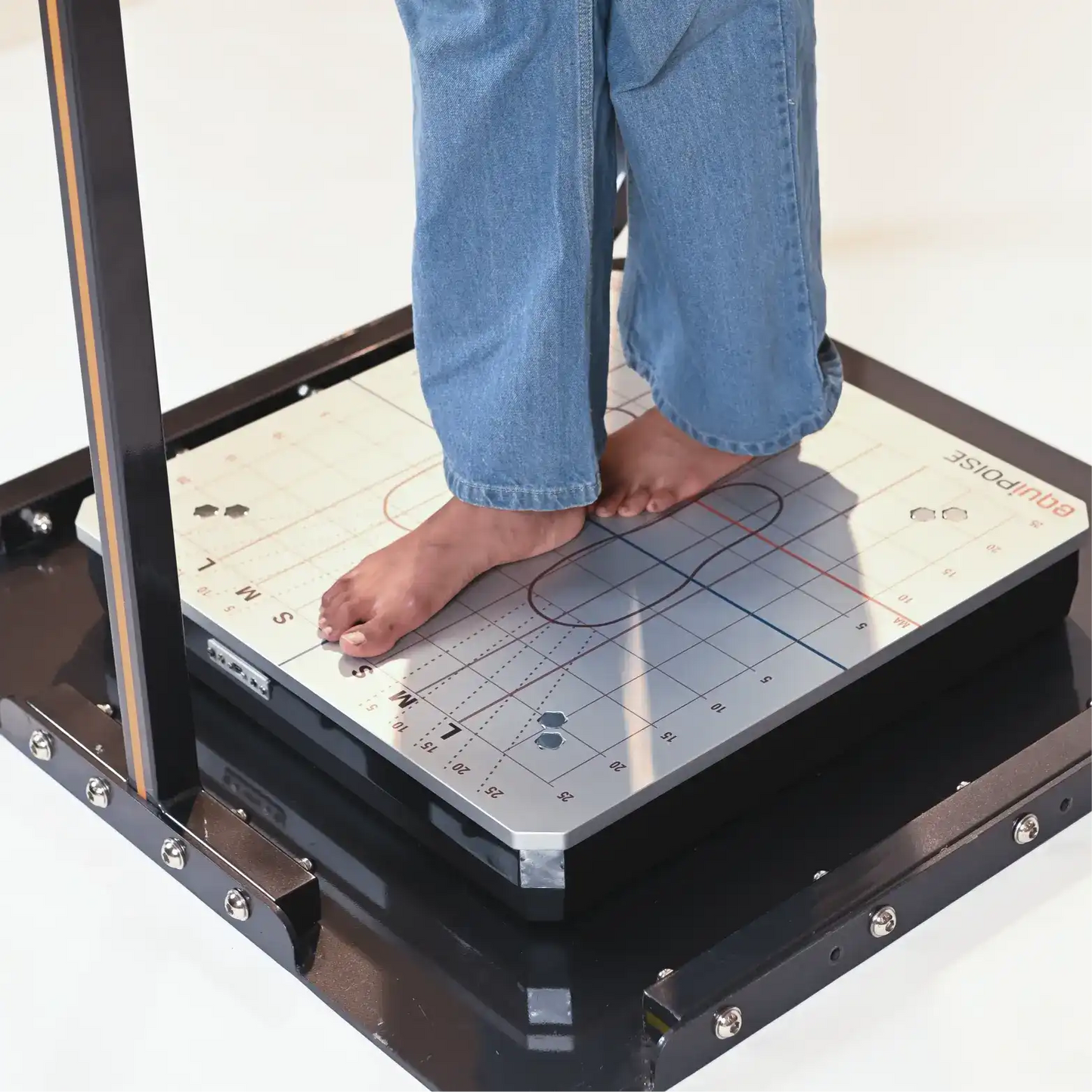
- It utilizes a forceplate platform and advanced software to acquire and analyze data on a patient's postural stability, sway characteristics, and weight distribution under various sensory and motor challenges.
- By delivering precise vestibular assessments with real-time data and customizable protocols, it empowers clinicians to make informed decisions for neurological, orthopedic, and sports rehabilitation plans.
Key features of EquiPoise
- Provides objective, precise analysis by eliminating inter-observer variation and subjectivity.
- Features a versatile 60x60 cm platform to accommodate diverse postural strategies on firm or cushioned surfaces.
- Offers customizable rehabilitation protocols with visual feedback to optimize patient recovery and engagement.
- Includes a tagging system for efficient patient record management and progress tracking.
- Assesses the limits of stability in eight directions to help unmask an increased risk of falls.
- Analyzes dynamic instability during tandem stances to screen for cerebellar dysfunction.
Clinical Uses of EquiPoise
Note: You may choose to use only the headings in the following section. The selection is at the discretion of the designer.
Vestibular Diagnostics: Delivers precise vestibular assessments and objective scores to evaluate the vestibular system.
Neurology & Neuro-Rehabilitation: For balance and gait assessment in stroke, Parkinson’s, and monitoring of other neuro disorders.
Orthopedic Clinics: To monitor post-surgical recovery and track musculoskeletal rehabilitation.
Sports Medicine: For injury rehabilitation, return-to-play readiness, and performance optimization.
Geriatric Care: To conduct fall-risk screenings and implement targeted balance improvement programs.
Physical Therapy: Utilizes real-time data and visual feedback to create individualized rehabilitation programs.
Who's a candidate?
- Patients with Parkinson’s Disease.
- Individuals recovering from a stroke.
- Patients diagnosed with Multiple Sclerosis.
- Individuals with Osteoarthritis affecting mobility.
- Patients recovering from Traumatic Brain Injuries.
- Individuals in post-surgical rehabilitation phases.
- Patients with gait disorders or abnormalities.
- Individuals with general balance and coordination issues.
FAQs
What is Equipoise?
Equipoise is a computerized posturography system featuring a platform and software designed for assessing and rehabilitating posture and balance.
How does the "escalating sensory denial" test work?
Itproceedsin four steps, sequentially removing visual and proprioceptive inputs to isolate and assess the vestibular system's contribution to balance.
What does the "escalating motor complexity" test assess?
This test evaluates cerebellar and gross motor function by requiring the patient to hold progressively more challenging stances, such as tandem and single-foot stands.
Can Equipoise quantify balance?
Yes, it provides objective scores such as a somatosensory score, a vestibular score, and an asymmetry ratio for motor function.
How does the system assess fall risk?
Tests like "weight-bearing squats" and "limits of stability"identify instability and can unmask an increased risk of falls in patients with neurodegenerative conditions or vestibular disorders.
What rehabilitation protocols are available?
It includes customizable protocols such as dynamic weight shifts, unipodal stance stability training, squats, and maze exercises to sharpen proprioceptive awareness and enhance stability.
What does the "rhythmic weight shifts" test measure?
This test assesses slow postural responses and the ability to smoothly shift weight by having the patient follow a target on the screen. A higher on-axis score suggests better stability.
What is the advantage over a traditional Romberg test?
Equipoise extends the Romberg test by providing objective, precise, and in-depth parameters that go beyond visual observation, there by eliminating subjectivity.
How does the system help patients with Parkinson's Disease?
It improves balance tracking and monitors changes in gait, which helps support therapy progression and disease management.
Can this be used for "return-to-play" decisions in athletes?
Yes, in sports medicine, it is used to assess injury rehabilitation and readiness to return to play by providing insights into gait and balance. However, the decision-making requires the collection of wider normative data.
How does the "tandem and stepping" test work?
It tests dynamic instability as the patient shifts from a normal to a tandem stance, which can help unmask cerebellar dysfunction or intoxication.
How does Equipoise support stroke recovery?
It assesses the patient's postural stability and provides data to guide rehabilitation protocols aimed at regaining mobility after a stroke.
What does the "limits of stability" test involve?
The patient is instructed to shift their weight toward targets in eight different directions on a screen to assess the range of motion they can sway without losing balance.
How are the "weight-bearing squats" analyzed?
The system studies quadriceps strength and coordination during squats at 30, 60, and 90 degrees. It represents instability through sway velocity and distance, with higher values suggesting a greater fall risk.
Does the system provide visual reports?
Yes, it calculates and provides time series and 2D position plots of the center of pressure for intuitive visualization of a patient's sway and stability.

Equipoise

Equipoise
Equipoise